Caregiver Types in Washington State

The job post says "caregiver." The training school says "HCA." The nursing home down the road wants a "CNA," and the agency your cousin works for calls everyone an "aide." In Washington, these are not the same job with different names.
They are different credentials, issued by different bodies, with different training behind them, and the one you hold decides where you can work and what you are allowed to do there.
It also decides what an employer has to check before letting you near a client. Here is how the state actually sorts caregivers, and what each credential takes.
Home Care Aide (HCA)

What is a home care aide? A home care aide is Washington's own caregiver credential, issued by the Department of Health under chapter 18.88B RCW. Since 2012, anyone hired as a long-term care worker in the state has needed HCA certification, whatever the job is called, unless they already hold a nursing credential or fall under one of the exemptions.
Where home care aides work. Home care agencies, adult family homes, assisted living facilities, and as individual providers caring for a Medicaid client at home. The requirement follows the setting, not the employer, which is what makes the HCA the broadest caregiver credential in the state.
Training and certification. 75 hours of DSHS-approved training, of which five (orientation and safety) must be done before giving any care. The 75 hours are due within 120 days of hire, then a two-part certification exam, written and skills, plus a $100 application fee to DOH. Certification must be issued within 365 days of hire. The full cost of HCA certification, training through exam, runs under $1,000.
What a home care aide can do. Activities of daily living: bathing, eating, medication assistance, toileting, mobility, and the household tasks around them. With the DSHS core delegation training on file, an HCA can also take nursing tasks delegated by a registered nurse.
Keeping the certification. Renews annually on the holder's birthday, with 12 hours of continuing education in between. Expired more than five years means repeating the training or the exam. The HCA renewal process is simpler than most people expect if the CE hours are already logged.
How to become one. Cornerstone runs the full 75-hour HCA program with the skills portion online under its DSHS pilot approval, and administers the certification exam in person at seven Washington locations.
Regulated by: WAC 246-980-020, -025, -040, -100, -110, -115, -130, -140, -990; RCW 74.39A.074; RCW 74.39A.341; chapter 246-12 WAC.
Nursing Assistant Certified (NAC)

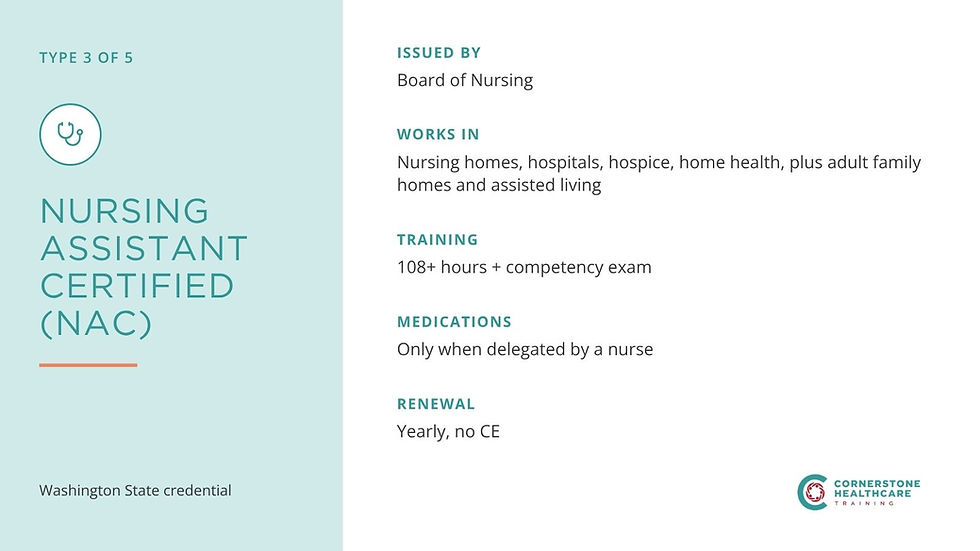
What is a nursing assistant certified? Washington's name for what the rest of the country calls a CNA. It's a certification under chapter 18.88A RCW, and since July 2026 it sits with the Washington State Board of Nursing rather than the Department of Health. A nursing assistant works under the direction of a registered nurse or licensed practical nurse, assisting with nursing care, which is the line that separates the credential from the HCA: a NAC answers to a nurse, an HCA answers to the setting.
Where nursing assistants work. Nursing homes, hospitals, hospice, and home health agencies, plus anywhere licensed nurses supervise them, including adult family homes and assisted living. Certification is only mandatory in nursing homes. Everywhere else it's voluntary unless another law requires it, and a NAC can also work as a long-term care worker without becoming an HCA.
Training and certification. A board-approved program of at least 108 hours: 35 of classroom theory, 33 of skills lab and 40 of clinical training, then a competency evaluation. An existing HCA can get there faster through a 36-hour alternative program, the route Cornerstone's HCA to CNA bridge program is built on. Application fee is $85. It also works the other way: a NAC who wants HCA certification skips the 70 hours of basic training and only sits the HCA certification exam.
What a nursing assistant can do. Nursing and nursing-related care as delegated by the supervising nurse. That does not include giving medications unless the task has been formally delegated, or unless the NAC holds the medication assistant endorsement covered below.
Keeping the certification. Renews every year on the holder's birthday, $95, with no continuing education requirement attached to the base credential. The medication assistant endorsement is the exception, and it renews separately.
How to become one. For someone already HCA-certified, the bridge program is the short route. For everyone else it's a full 108-hour program through a board-approved provider.
Regulated by: RCW 18.88A.020, .030; RCW 18.88B.041; WAC 246-841A-403, -420, -545, -990.
Nursing Assistant Registered (NAR)
What is a nursing assistant registered? The entry level of the nursing assistant credential under chapter 18.88A RCW. Registration is what lets someone work as a nursing assistant before they are certified, typically while they are in a training program or waiting to sit the competency evaluation. It's a registration, not a certification: there is no exam to get it, and it doesn't prove competence on its own.
Where nursing assistants registered work. The same settings as a NAC, most often nursing homes, where a new hire has to apply for registration within three days of starting. A facility cannot assign a NAR to provide care until the person has shown they can do every duty they are given. In a nursing home the NAR has to become certified within the federal deadline; elsewhere the timeline depends on the setting.
Training and certification. None required to register, which is the point of it. What follows is the NAC training and competency evaluation. Someone hired as a long-term care worker while in an approved nursing assistant program is exempt from HCA certification, but only if they finish the program within 120 days of hire and hold the NAC credential within 365 days. Application fee is $85.
What a nursing assistant registered can do. The nursing assistant scope, under nurse supervision, limited to tasks the person has demonstrated. No medication administration.
Keeping the registration. Renews every year on the holder's birthday, $95. A NAR is not meant to be a long-term status; the credential exists to be replaced by certification.
How to become one. Apply to the Board of Nursing. The useful question is what comes next, and for most people that's either the full NAC program or, if they hold an HCA, the 36-hour bridge to certification.
Regulated by: RCW 18.88A.020, .030, .040; WAC 246-841A-403, -990; WAC 246-980-025.
Medication Assistant

What is a medication assistant? Not a separate credential but an endorsement added to a NAC, created by RCW 18.88A.082 and issued by the Board of Nursing. It lets a nursing assistant give certain medications and do certain simple treatments, which a nursing assistant otherwise cannot do without a nurse delegating each task. Only someone who holds the endorsement may use the title.
Where medication assistants work. Nursing homes only. The endorsement has no effect anywhere else: a medication assistant working in an adult family home or assisted living is just a NAC there. Even inside a nursing home, the tasks can only be done under the direct supervision of a designated registered nurse who is on site and immediately reachable during the shift, and who assesses the resident before each administration.
Training and certification. A NAC in good standing with at least 1,000 hours of nursing home work in the year before applying, a board-approved program of at least 100 hours (50 classroom, 10 skills lab, 40 clinical practicum), then a competency exam. Endorsement fee is $25.
What a medication assistant can do. Administer medications orally, topically and by inhalation, and perform simple prescriber-ordered treatments such as blood glucose monitoring, non-complex clean dressing changes, pulse oximetry and oxygen administration, documenting all of it. The decision to give the medication stays with the RN.
Keeping the endorsement. Renews with the NAC credential each year, $10, and needs two things every year: 250 hours of documented work as a medication assistant under RN supervision, and eight hours of continuing education specific to medication administration and the permitted treatments.
How to become one. Through a board-approved medication assistant program after the nursing home hours are in. There's no shortcut from HCA; the endorsement sits on the NAC, so the bridge to NAC comes first.
Regulated by: RCW 18.88A.020, .082; WAC 246-841A-407, -590, -595, -990.
Long-Term Care Workers Without a Credential

Who are they? Caregivers the state pays but does not certify. Washington exempts several groups from HCA certification, almost all of them people looking after their own family at home as individual providers. They are still long-term care workers under RCW 74.39A, with training requirements of their own, just shorter ones.
Where they work. In the home of the person they care for, almost always as an individual provider paid through the Consumer Directed Employer for a Medicaid client. The same exemption also covers respite-only providers and anyone giving 20 hours or less of care a month to one person.
Training requirements. They depend on who is being cared for. A parent caring only for their developmentally disabled child does 12 hours. Since July 2026, a spouse or registered domestic partner caring only for their partner does 15 hours of basic training plus at least six hours focused on the partner's needs. A respite-only provider working 300 hours or less a year does 14. Anyone caring only for a child, parent, sibling, aunt, uncle, cousin, niece, nephew, grandparent or grandchild, or giving 20 hours or less a month, does 35. All of it is due within 120 days, and where the track is 14 or 35 hours, five of them, orientation and safety, come before any care is given.
What they can do. The same personal care as an HCA, for that one person. The exemption follows the relationship: care for anyone outside it, or for more than 20 hours a month, and full certification applies.
Keeping it current. Nothing to renew, since there is no credential. Continuing education is where it changes from January 2027, when workers caring for a relative other than their own child start owing the same 12 hours a year as everyone else.
Becoming certified anyway. An exempt worker can choose HCA certification, but then the full 75 hours and the exam apply. That is the route for a family caregiver who wants to work for an agency or facility later.
Regulated by: RCW 74.39A.076; RCW 74.39A.341; WAC 246-980-025; RCW 74.39A.500.
Which credential matters less than where it lets you stand. A NAC can work almost anywhere but only ever under a nurse. An HCA can walk into an adult family home, an agency or a client's living room without one. A family caregiver on a 35-hour track can do everything an HCA does, for exactly one person.
For employers the question runs the other way: the setting picks the credential, and the hiring date starts the clock. Whichever side you are on, the 75-hour HCA program is where most Washington caregivers start, and the credential the others are measured against.