Home Care Intake Form: What to Ask Before Taking On a New Client

The call sounds simple. A daughter needs someone with her father three mornings a week, starting Monday, and you say yes. By the second week your caregiver reports that he cannot stand without two people, that he takes eleven medications, and that the family expected overnight cover from the start.
Nobody lied. Nobody asked.
A home care intake form moves those discoveries from week two to the first conversation, while you can still plan for them or decline. It turns a hopeful phone call into a record of who the client is, what they need, and whether your team is the right one to provide it.
What a Home Care Intake Form Is
A home care intake form is the document a provider fills in with a prospective client, or with the family, before agreeing to services. It records who the person is, what help they need, where and when care will happen, and who pays and decides.
It is the first of three records, and the lightest.
The intake form captures what the client and family tell you.
An assessment follows, when someone from your team sees the person and the home and checks those answers.
The care plan comes last and sets out what your caregivers will do on each visit.
Non-medical home care and home health use different paperwork. Home health is the medical side, with skilled nursing and therapy, so an intake form for home health care is a clinical document. A non-medical provider needs a simpler form built around daily life.
What to Include in a Home Care Intake Form
Six parts cover what a provider needs to know before saying yes.
Client and Contact Details
Start with the person receiving care: full name, date of birth, address, phone, and preferred language. Add the caller's name and relationship, because the person arranging care is often a son, daughter, or spouse. Record at least one emergency contact who lives nearby and the name of the primary doctor.
Health Conditions and Medications
Ask for diagnoses in plain words, including memory loss, mental health conditions, diabetes, and recent hospital stays. List every medication and who manages it now. Note allergies, special diets, and any equipment in use, such as oxygen, a catheter, or a feeding tube. These answers decide which of your caregivers can take the client, so a vague reply deserves a follow-up question.
Daily Living Needs
Go through the day task by task: bathing, dressing, toileting, eating, moving from bed to chair, walking, and taking medications. For each one, write whether the client manages alone, needs a reminder, needs hands-on help, or needs two people. Then cover the household side, which includes meals, laundry, shopping, and rides to appointments.
Home Environment and Safety
Your caregiver will work in this home, so ask about it. Stairs, a tub or a walk-in shower, pets, smokers, and firearms all change how a visit runs. Ask who else lives there and whether the client has fallen in the past six months.
Schedule and Service Expectations
Write down the days, hours, and start date the family wants, and whether they expect the same caregiver on every visit. Ask about overnight care and weekends now. Families often assume both are included.
Payment and Decision Makers
Record who pays: the client, the family, long-term care insurance, or a state program. Ask whether anyone holds power of attorney or guardianship, since that person may need to sign the service agreement. Confirm who should receive updates and who may change the schedule.
Questions to Ask During the Intake Conversation
A form collects facts. The conversation around it tells you whether the arrangement will last, and a few open questions do most of that work.
Start with what a good day looks like for the client, and what a hard one looks like. The answer shows the routine your caregiver walks into and the moments when help matters most.
Find out whether the family has used a caregiver or an agency before, and why it ended. A family on its fourth provider this year is telling you something. So is one that kept the same aide for six years.
Ask the client, not only the family, how they feel about receiving help. Care arranged by a daughter for a father who does not want it starts differently from care the client asked for.
Then ask what would make the family call you to complain. People answer this one honestly, and the answer becomes the standard your team is measured against.
Finish with what has changed in the last three months. A recent fall, a new diagnosis, or the death of a spouse often explains the call better than anything on the form.
What the Answers Mean for Staffing and Training
Every answer about health points at a caregiver. A client with dementia needs someone trained for dementia, and a client with a mental health condition needs someone trained for that.
In Washington's adult family homes, assisted living facilities, and enhanced services facilities, this is a rule. Workers who serve residents with dementia, mental health needs, or developmental disabilities must hold the matching specialty training, and one class does not substitute for another. For a new hire, specialty training finished within 120 days of the hire date also counts toward population specific training, so the class does double duty.
An in-home agency can run the same check. Read the intake form against your roster before you accept, and match each condition to a caregiver who has trained for it. If nobody on the team has, the start date depends on how fast someone can.
Medication answers work the same way. Before promising help with insulin or any other medication, check what caregivers can and cannot give, and whether the task calls for nurse delegation.
When to Say No to a Client
An intake form is also how you find the clients you should not take. Decline, or delay, when the needs on the form go beyond what your team is trained and staffed to do. Two-person transfers with one caregiver on the schedule, or a task nobody is trained for, put both the client and your caregiver at risk.
Hours are another reason. A family that wants seven days a week when you can cover four will be unhappy by the second weekend, however good the care is.
Pay attention to how the conversation went, too. A family that will not answer questions about health or medications, or that argues with every policy before care begins, rarely becomes easier later.
Saying no is easier with somewhere to send people. Keep a short list of other providers and local resources, and a declined inquiry can still end with the family glad they called.
HIPAA and the Privacy of Intake Information
An intake form is a page of protected health information. Name, address, phone number, diagnoses, mental and physical conditions, and medications all count as PHI under HIPAA, so handle the form to that standard from the first line.
Treat it the way your caregivers are trained to treat a chart. Only people directly involved in the client's care should read it, and each of them needs only the parts relevant to their work. Keep paper copies in a locked file and digital copies in a password-protected system, and never send a completed form by personal email or text. The HIPAA rules for caregivers apply in the office as much as on a visit.
Two additions to the form make this easier. The first is a privacy acknowledgment that the client or their representative signs. The second is a line naming the people the client authorizes you to speak with. The daughter who made the call may not be someone the client wants updated, and getting those names in writing at intake saves your caregivers from awkward refusals later.
Other Home Care Client Forms to Keep With It
The intake form is the first of the home care forms in a client file. Four more home care client forms usually sit behind it.
The service agreement sets out the services, the rate, the schedule, and the terms for cancelling.
The care plan turns the intake answers and the assessment into tasks for each visit.
An emergency information sheet puts contacts, the doctor's number, allergies, and medications on one page a caregiver can hand to paramedics.
A consent and authorization form records who may receive information and who may make decisions.
Kept together, the five let anyone on your team pick up a file and understand the client in ten minutes.
Download the Free Home Care Intake Form (PDF)
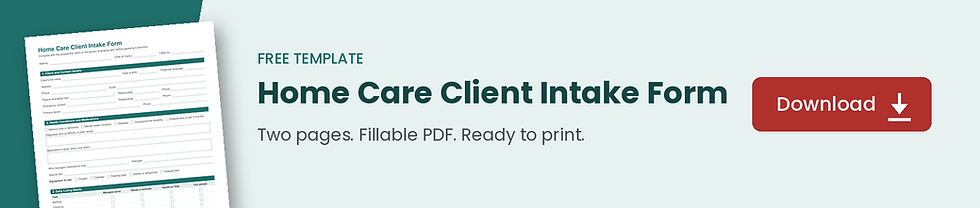
The free home care client intake form is a two-page fillable PDF with all six parts, plus a privacy acknowledgment and a list of authorized contacts at the end. Print it for phone inquiries and home visits, or fill it in on screen. Add your logo and adjust the questions to the services you offer.

Ask Before You Say Yes
Most problem clients were never problem clients. They were people whose needs nobody wrote down before the first visit. An intake form costs twenty minutes and one honest conversation, and it gives you the two things a home care business runs on: the right caregiver in the right home, and a family whose expectations match what you agreed to deliver.
Use it on every inquiry, including the ones that sound easy. When the answers show a gap in your team's training, Cornerstone Healthcare Training can close it with caregiver staff training in dementia, mental health, and nurse delegation, online and at your team's pace.